Signal Processing Concepts and Engineering Insights.
Explore signal processing concepts, algorithm comparisons, and practical engineering insights. Topics include FFT vs STFT, FRF analysis, filtering techniques, and other signal processing methods used in real engineering workflows.
Understanding Voice Signals: Time Domain, Frequency Domain, and STFT Analysis
When analyzing real-world signals, audio data is one of the most intuitive and insightful examples. Unlike abstract signals, audio allows us to both see and hear the results of signal processing.
In this post, we will explore how voice signals can be analyzed across multiple domains
Time domain (raw waveform)
Frequency domain (power spectrum)
Time-frequency domain (STFT, spectrogram)
We will compare two audio signals labeled as “boy” and “girl”, and understand what makes them different from a signal processing perspective.
Time Domain: What Does the Signal Look Like?
Girl's Voice
Girl's voice (refer to Samples/voice spectrogram.mmj)
The waveform shows how amplitude changes over time.
Key observations
Higher overall amplitude variation
More dense oscillations
Faster temporal variations
Boy's Voice
Boy's voice (refer to Samples/voice spectrogram.mmj)
Compared to the girl's voice signal
Slower oscillations
More stable envelope(amplitude)
Lower frequency components dominant
This is where signal processing becomes powerful — you can correlate what you hear with what you see.
Frequency Domain: Power Spectrum
Power Spectrum Comparison
Power Spectrum of girl and boy's voice (refer to Samples/voice spectrogram.mmj)
The power spectrum reveals how signal energy is distributed across frequencies.
Key differences
Feature
Girl voice
Boy voice
Dominant frequency
High frequencies
Lower frequencies
Harmonic spacing
Wider
Narrow
Energy distribution
Spread out
Concentrated
Interpretation
The girl voice contains stronger high-frequency components
The boy voice is dominated by lower fundamental frequencies
This aligns with typical human vocal characteristics.
Time-Frequency Domain: STFT Analysis
The Short-Time Fourier Transform (STFT) shows how frequency content evolves over time.
STFT – Girl Voice
Spectrogram of girl's voice (refer to Samples/voice spectrogram.mmj)
Features
Harmonics extend to higher frequencies
More complex spectral patterns due to wider harmonic spacing, stronger formant variation, and richer high-frequency content
Stronger high-frequency presence
STFT – Boy Voice
Spectrogram of boy's voice (refer to Samples/voice spectrogram.mmj)
Features
Harmonics appear at lower frequency bands
Clear horizontal structures (stable pitch)
Less high-frequency energy
Why STFT Matters in Audio Analysis
A simple FFT gives you frequency information, but it loses time resolution.
STFT solves this problem.
Method
Time Info
Frequency Info
Time series data
Yes
No
FFT
No
Yes
STFT
Yes
Yes
This makes STFT essential for
Speech analysis
Music processing
Fault diagnostics using acoustic signals
Connecting What You See and Hear
This example highlights an important principle
Signal processing becomes significantly more intuitive when visual and auditory feedback are combined.
By listening to the audio while observing
Waveform → loudness and timing
Spectrum → pitch and harmonics
Spectrogram → evolving frequency component
you gain a much deeper understanding of the signal.
Practical Insight
From an engineering perspective
Voice signals are inherently non-stationary
Time-frequency analysis is mandatory
High-frequency components often relate to clarity and articulation
This is why tools that support both visualization and playback are extremely valuable in real workflows.





Understanding Voice Signals: Time Domain, Frequency Domain, and STFT Analysis
In this post, we will explore how voice signals can be analyzed across multiple domains
We will compare two audio signals labeled as “boy” and “girl”, and understand what makes them different from a signal processing perspective.
Time Domain: What Does the Signal Look Like?
Girl's Voice
The waveform shows how amplitude changes over time.
Key observations
Boy's Voice
Compared to the girl's voice signal
This is where signal processing becomes powerful — you can correlate what you hear with what you see.
Frequency Domain: Power Spectrum
Power Spectrum Comparison
Power Spectrum of girl and boy's voice (refer to Samples/voice spectrogram.mmj)
The power spectrum reveals how signal energy is distributed across frequencies.
Key differences
Interpretation
This aligns with typical human vocal characteristics.
Time-Frequency Domain: STFT Analysis
The Short-Time Fourier Transform (STFT) shows how frequency content evolves over time.
STFT – Girl Voice
Spectrogram of girl's voice (refer to Samples/voice spectrogram.mmj)
Features
STFT – Boy Voice
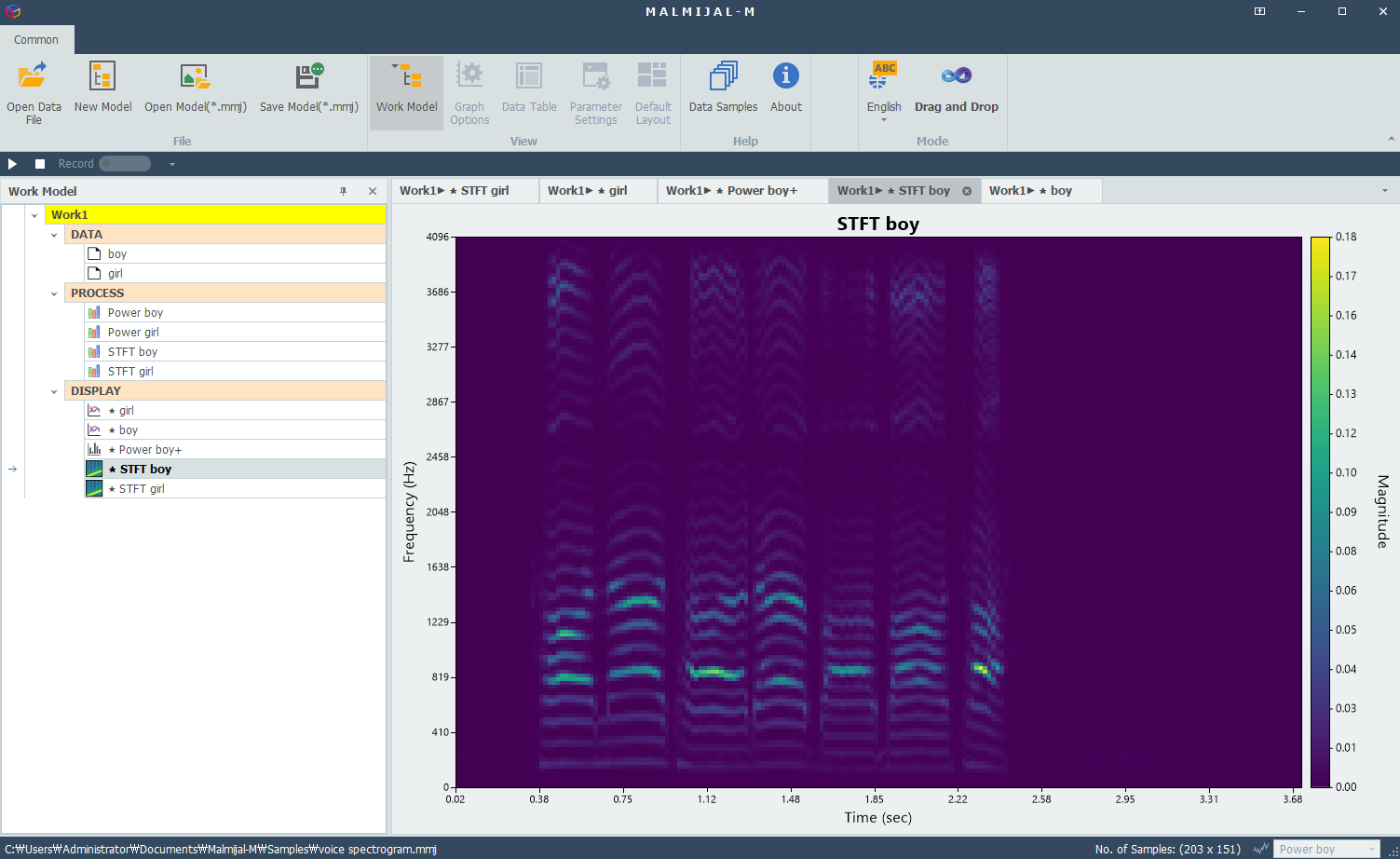
Spectrogram of boy's voice (refer to Samples/voice spectrogram.mmj)
Features
Why STFT Matters in Audio Analysis
A simple FFT gives you frequency information, but it loses time resolution.
STFT solves this problem.
This makes STFT essential for
Connecting What You See and Hear
This example highlights an important principle
By listening to the audio while observing
you gain a much deeper understanding of the signal.
Practical Insight
From an engineering perspective
This is why tools that support both visualization and playback are extremely valuable in real workflows.
Suggested Further Reading
#You may also find these topics helpful: